
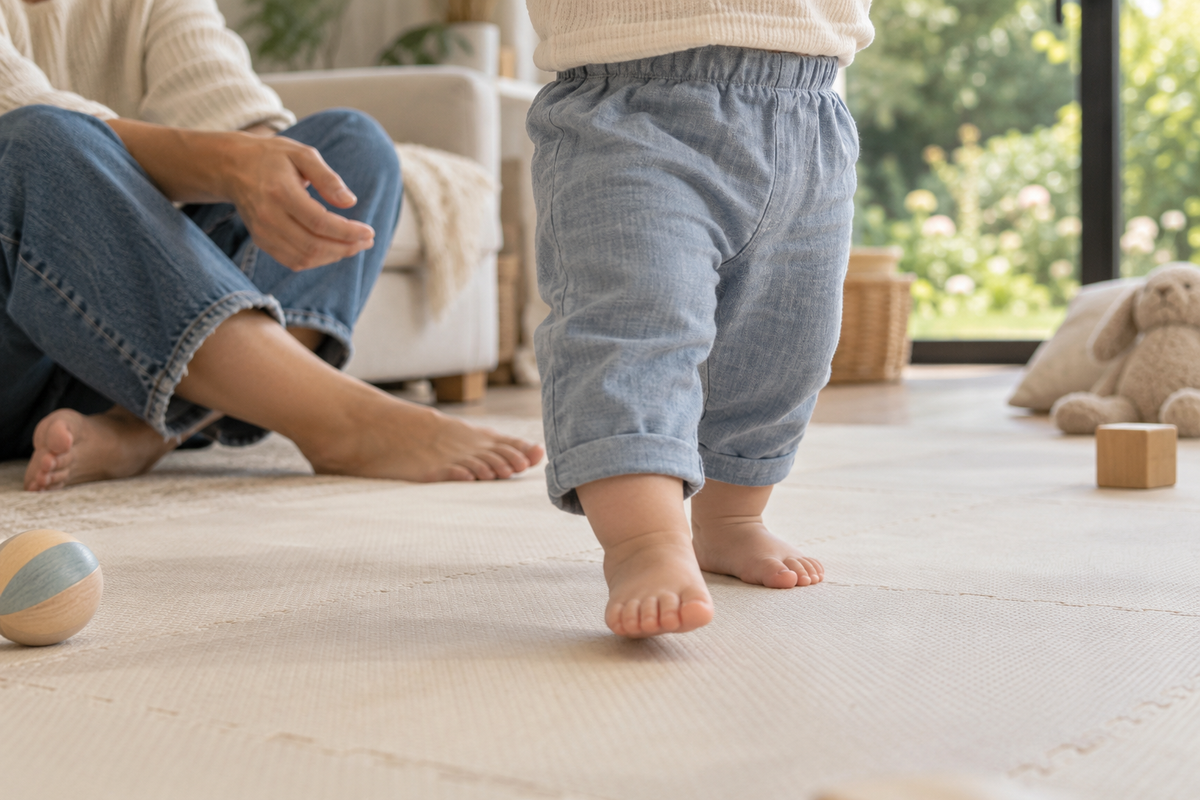
Make space.
A clear, supervised place gives little explorers room to practice.
Notice progress.
Use milestone guidance to help you follow their development.
Stay curious.
If something concerns you, bring it up with your child's doctor.
There is more to a first step.
Pulling up. Holding on. Stepping sideways. Letting go for a moment. Early walking brings these small actions together. A wider stance and a return to crawling can be part of the learning process described by the American Academy of Pediatrics.[1]
For families, this is a time to notice the everyday discoveries as well as the big milestone. A pause, a change of direction or a few steps toward you can be a moment worth enjoying.
What do the milestone checklists say?
A simple place to practice.
Start with an ordinary moment: clear a familiar play area, stay nearby and give your child time to explore. Choose a stable surface, keep hazards out of reach and secure furniture they might use to pull up. These ideas reflect the AAP's movement guidance and the CDC's advice to create safe spaces for play.[1][2]
Where do shoes fit into the picture?
For walking outside, the AAP recommends comfortable, flexible, closed-toe shoes with nonskid soles and growing room. It also recommends regular fit checks.[1]
At Pedibare, toe room and flexibility are part of our everyday design approach. The right fit still matters as their feet grow.
Keep exploring.
- American Academy of Pediatrics — Movement Milestones in Babies 8 to 12 Months Old. Movement and first-shoe guidance.
- CDC — Milestones by 15 Months. Milestone monitoring and when to seek advice.
- CDC — Milestones by 18 Months. Independent walking and wider development.
General educational information. Your child's clinician can advise on their individual development.